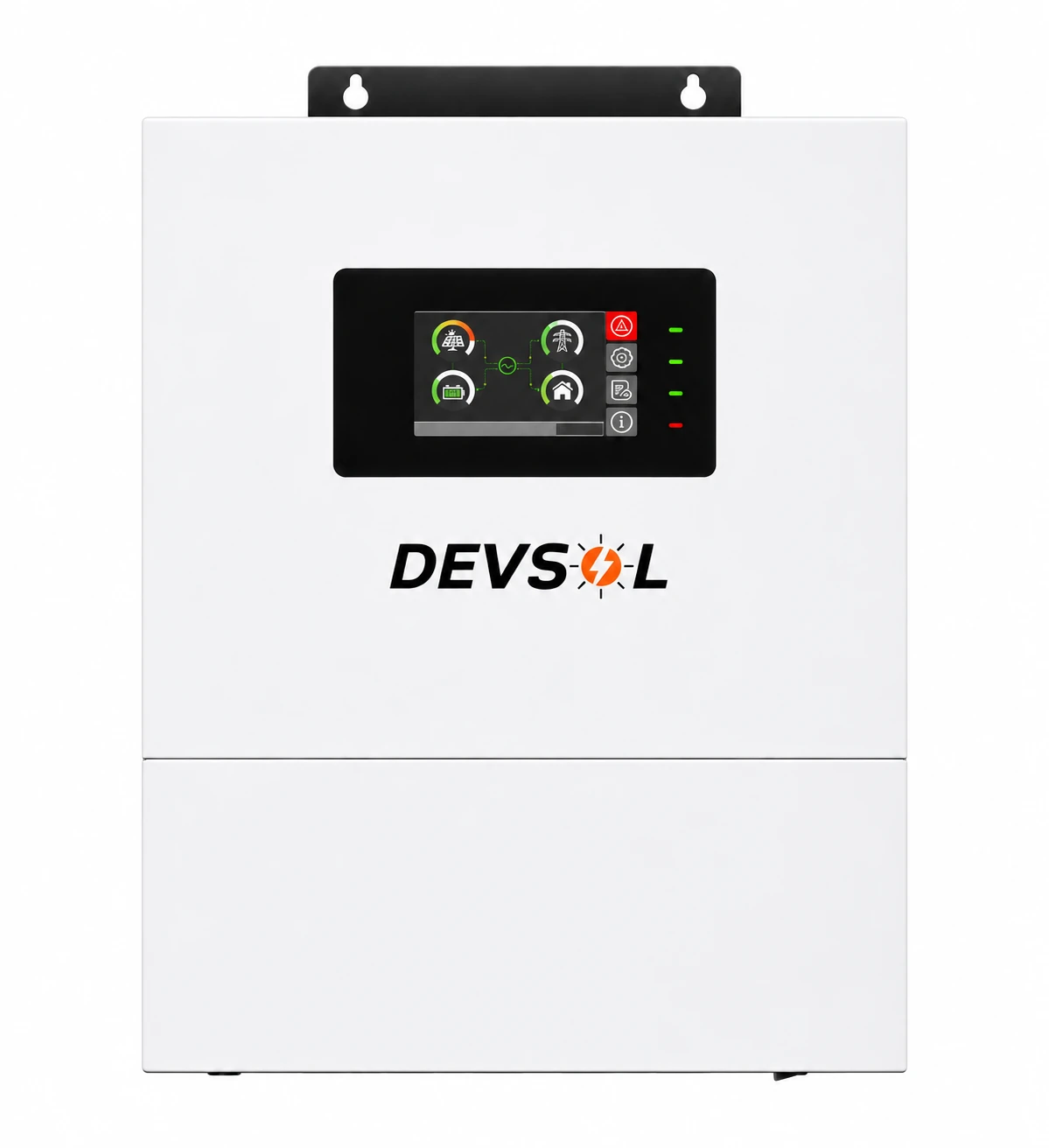
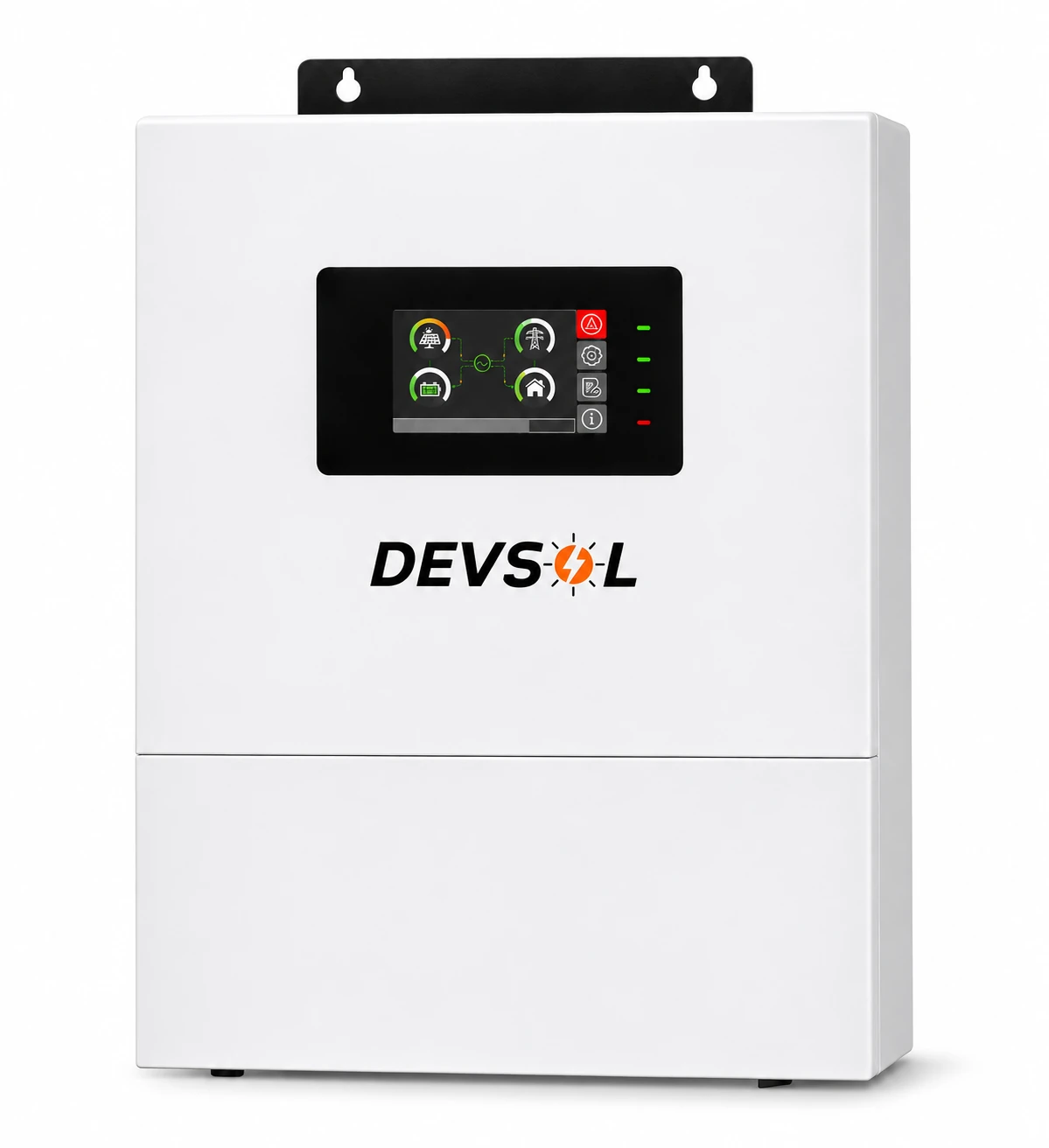
Unit price ₹85,000 + 5% GST (₹89,250 including GST).
6 kW hybrid output with two independent solar trackers
The Devsol DEV HYD 6KW Dual MPPT supplies up to 6,000 W of rated pure sine wave AC output from a nominal 48 V battery architecture. Two independent PV trackers support up to 8,000 W combined, with up to 4,000 W and 16 A input per tracker. It suits homes and small commercial sites that need more running load capacity and want to design two solar strings around different roof orientations or shade patterns.
Each MPPT operates over 60–450 V DC, with a 500 V maximum array open-circuit voltage. Two independent trackers let each connected string find its own operating point. A string on the east side and a string on the west side can therefore operate at different voltages. The inverter's input limits apply to each tracker individually. The 60 V figure is the lower tracking boundary. Confirm the startup threshold for the supplied unit when designing a short string.
Battery design and current at rated power
Electrical and environmental specifications
| Parameter | Rating |
|---|
| Rated output | 6,000 W / 6,000 VA |
|---|
| Surge apparent power | 12,000 VA |
|---|
| Nominal battery voltage | 48 V DC |
|---|
| Supported battery types | Compatible lithium and lead-acid |
|---|
| Maximum PV array power | 8,000 W total (2 × 4,000 W) |
|---|
| PV trackers and strings | 2 MPPT / 2 strings |
|---|
| Maximum PV input current | 16 A per MPPT (2 × 16 A) |
|---|
| MPPT operating range | 60–450 V DC |
|---|
| Maximum PV array open-circuit voltage | 500 V DC |
|---|
| Nominal AC input | 230 V AC |
|---|
| Selectable AC input range | 170–280 V computer mode, 90–280 V appliance mode |
|---|
| AC input frequency | 50/60 Hz, auto sensing |
|---|
| Battery-mode AC regulation | 230 V AC ±5% |
|---|
| Output frequency and waveform | 50/60 Hz, pure sine wave |
|---|
| AC output circuits | Two outputs with load management, within total inverter rating |
|---|
| Peak inverter efficiency | 93% published peak |
|---|
| Typical transfer time | 10 ms computer mode, 20 ms appliance mode |
|---|
| Maximum solar charging current | 120 A |
|---|
| Maximum AC charging current | 100 A |
|---|
| Maximum combined charging current | 120 A |
|---|
| Cabinet ingress protection | IP54 |
|---|
| Operating ambient temperature | −10°C to +50°C |
|---|
| Relative humidity | 5–95%, non-condensing |
|---|
| Altitude | Derating at 2,000 m |
|---|
| Monitoring and service interfaces | RS232 and USB. Optional Wi-Fi |
|---|
| Battery communication | CAN / RS485 for compatible BMS |
|---|
| Parallel option | Up to six matching units with supported configuration and accessories |
|---|
| Safety standards referenced | EN/IEC 62109-1 and EN/IEC 62109-2 |
|---|
At a nominal 48 V, 6,000 W corresponds to about 125 A DC at ideal efficiency. With a 90% illustrative conversion assumption, it is about 139 A. Lower battery voltage under load increases current. Use the battery maker's permissible continuous and surge discharge currents, together with the inverter manual, to size the battery bank, BMS, disconnect, fuse and cables.
A 51.2 V, 100 Ah lithium pack stores 5.12 kWh nominal. At 80% usable energy and an assumed 90% battery-to-AC efficiency, approximately 3.69 kWh reaches the load. At a constant 1.5 kW, that is about 2.46 hours under the example assumptions. A single pack limited to 100 A by its BMS provides about 5.12 kW DC at nominal voltage, before conversion loss. A bank capable of more continuous current is needed to run the inverter at 6 kW. A compatible battery design should also account for startup transients, BMS current sharing, temperature and voltage sag.
The inverter lists up to 120 A solar charging, up to 100 A AC charging and up to 120 A total charging. Program the limit for the installed battery. When both charging sources contribute, the combined limit remains 120 A. For lithium, confirm the pack's CAN or RS485 protocol, wiring and charge permissions. Configure lead-acid charging for the actual battery manufacturer's voltage, temperature and current requirements.
Worked two-string PV layout
Assume 550 W modules, each rated at 49.5 V Voc, 41 V Vmp and 13 A operating current, with a Voc temperature coefficient of −0.28%/°C. Put seven modules in series on each of the two MPPTs. Each string is 3,850 W and the combined PV nameplate is 7,700 W. At a design cell temperature of −5°C, calculated open-circuit voltage is about 376 V per string. At 70°C cell temperature with an assumed Vmp coefficient of −0.32%/°C, operating voltage is about 246 V per string. The example stays within the documented wattage and voltage limits under those assumptions.
Check actual module Isc, the inverter's permitted short-circuit current, connector ratings and bifacial current gain before selecting modules. Two 13 A strings on the same tracker would total roughly 26 A operating current, above its 16 A limit. The example uses one string per tracker. Use both inputs to reach the combined capacity while keeping each below 4,000 W.
AC output and site integration
The two managed AC outputs allow essential and secondary circuits to be organized separately. The total inverter rating remains 6,000 W. At a power factor of 1, 6,000 W at 230 V is about 26.1 A. Design AC circuits and protection around the manual and site conditions. The rated surge is 12,000 VA. Match starting VA and the required duration before assigning motors or compressors.
The inverter lists 10 ms transfer in computer mode and 20 ms in appliance mode. The 170–280 V and 90–280 V ranges are the corresponding AC input acceptance windows. Test sensitive loads during commissioning. Configured solar-plus-grid battery-less operation is supported. Include a battery in designs that require dependable backup in an outage. Utility interconnection and export depend on the exact approved configuration and site permissions.
Where the 6 kW Dual MPPT model is the best fit
Choose it for sites with a compatible 48 V battery bank, essential loads that fit a 6 kW inverter, two useful roof strings and a sheltered installation point. Its two trackers make the roof layout more flexible, especially when strings face different directions. The specified low end of the MPPT operating range leaves room for hot-string voltage to fall, subject to the exact startup and current requirements.
Commissioning checklist
- Assign PV strings to trackers and record the cold Voc, hot Vmp, power and current for each.
- Verify loaded battery voltage and battery current during a controlled load test, using the correct BMS settings.
- Verify essential and secondary output behavior in each commissioned operating mode.
- Confirm transfer timing is suitable for connected equipment, especially controls and sensitive electronics.
- Record battery limits, protection settings and the PV design. Leave ventilation and service clearances at the mounting position.
Frequently asked questions
Which battery voltage does the Devsol 6 kW Dual MPPT use?
It uses a nominal 48 V DC battery bank. Configure a compatible lithium or lead-acid bank for the intended load.
How much PV can I connect to the two MPPTs?
Up to 8,000 W combined, with up to 4,000 W and 16 A per tracker, inside the specified voltage and current limits.
Can I connect east- and west-facing strings?
Yes. Assign one string to each independent tracker and size each against its own voltage, current and power limits.
Is one 51.2 V, 100 Ah battery enough?
Check the battery's discharge current. A 100 A BMS supplies about 5.12 kW DC at nominal voltage before conversion loss, so that example cannot sustain a full 6 kW AC load.
Does it support parallel operation?
The datasheet lists optional parallel operation for up to six matching units. Confirm the supplied variant, firmware and parallel accessories for the intended installation.
Is this the same as the Devsol INNO 9G Pro IP65?
This product is the DEV HYD 6KW Dual MPPT with IP54 and 8,000 W PV input. Use the exact model listing when comparing enclosure protection and PV ratings.
Where do I get setup or warranty support?
Email info@devsolenergy.com with the model, serial number and installation details.
Gallery shows Devsol product renders.
Compare the Devsol 4 kW, 24 V Single MPPT inverter and see the hybrid inverter buying guide for load, battery and roof layout guidance.
For product and warranty support, email info@devsolenergy.com.