For a single-phase shop needing a 48V battery system and an outdoor-rated inverter, our recommended starting point is the Devsol INNO 9G Pro 6kW IP65 hybrid inverter; select a 24V or three-phase model when the essential loads and electrical design call for it. The best hybrid inverter for a business is the model that keeps the right circuits working, fits the available solar and battery system, and comes with a practical service plan.
A billing counter and a workshop do not need the same backup design. A shop may want refrigeration and payments to continue during a power cut; an office may prioritise computers, networking and lights. A workshop may have a motor whose starting demand matters more than its average energy use. This guide helps you turn those requirements into an exact Devsol model and a complete system proposal.
How to choose a hybrid inverter for shops and offices
Write down what a power cut actually interrupts. At a retail counter it might be card payments, weighing equipment and a router. At a pharmacy it could include a refrigerator with specific temperature requirements. In an office it may be computers, security equipment and communications. Each device also has its own acceptable interruption time: the word “hybrid” does not by itself promise uninterrupted operation for every appliance.
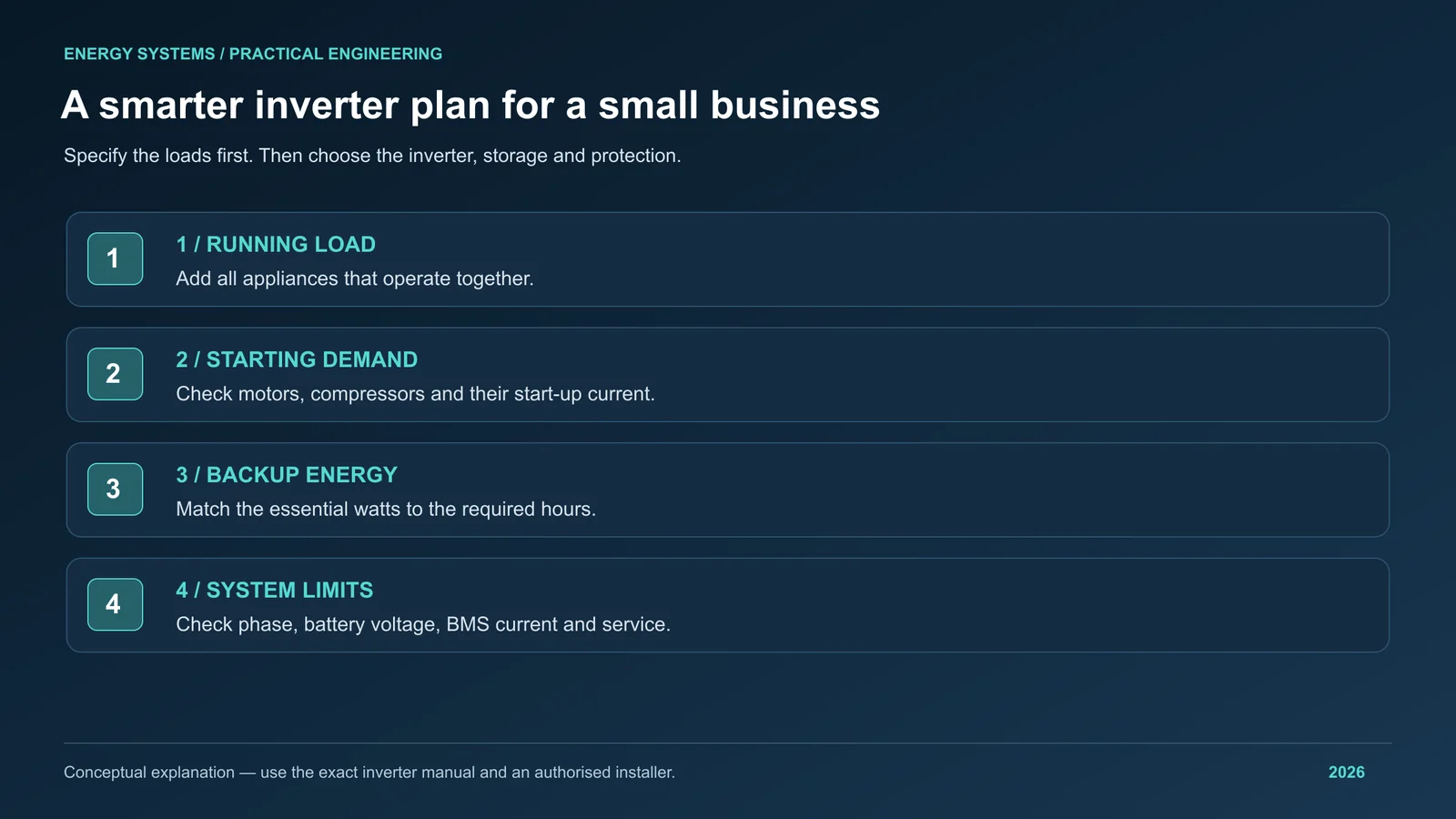
Separate the proposal into three questions:
- Running power: which devices operate together, and what is their measured or nameplate input in watts?
- Starting and switching: which compressors, pumps or machines have a starting surge, and what interruption can the equipment tolerate?
- Stored energy: how long should those circuits operate when there is insufficient solar and no grid supply?
A larger inverter answers only part of the first question. It does not create more battery energy, raise a battery BMS current limit or make an unsuitable motor compatible.
Devsol models to shortlist for shops and small businesses
| Business requirement | Model to assess | What to confirm in the proposal |
|---|---|---|
| Single-phase shop or office; indoor equipment position | Devsol DEV HYD 5kW 24V, IP54 | 24V-class battery design, essential-load output and starting capability; four-year inverter warranty, subject to terms. |
| 48V battery system with an outdoor-rated inverter requirement | Devsol INNO 9G Pro 6kW 48V IP65 | Exact backup output, battery limits and PV-string design; five-year inverter warranty, subject to terms. Follow the specified installation clearances and environmental limits. |
| Three-phase business supply and a suitable larger installation | Devsol 15kW three-phase IP66 model | Phase loading, battery current, generator configuration and the exact commissioning manual; five-year inverter warranty, subject to terms. |
These are starting points for a design conversation, not interchangeable variants. The 24V and 48V models require different battery arrangements. The three-phase model must not be treated as an unrestricted 15kW supply on one phase. The current product listing, matching manual and accepted quotation establish the supplied configuration.
Build an essential-load schedule
For a shop, list the billing computer, printer, router, security equipment, lights and any refrigeration separately. Record both the input rating and whether each device runs continuously. For a workshop, list the machine manufacturer and motor details instead of describing everything as “one machine”. For an office, distinguish the server or network equipment from optional air conditioning.
| Circuit | Include in the record | Why it matters |
|---|---|---|
| Billing, networking and security | Simultaneous watts and acceptable interruption time | Business continuity can depend on a small but sensitive load. |
| Refrigerator, pump or compressor | Running input, starting demand and duty cycle | A short starting event can exceed the steady operating load. |
| Air conditioner | Electrical input under the intended conditions | Tonnage describes cooling capacity, not a fixed electrical draw. |
| Workshop machinery | Phase, voltage, start method and operating schedule | Motor compatibility and phase balance need a specific design. |
Put optional circuits on a separate list. If an appliance can wait until solar is available or grid power returns, it should not silently consume the battery reserve intended for your counter, communications or refrigeration.
Daytime savings and evening backup are different
During suitable sunlight, a supported hybrid model can use solar to serve the load and manage battery charging. Depending on the selected operating mode, available sources and configured limits, the grid may support the load or charge the battery. After sunset there is no solar generation: the system needs grid power or stored battery energy.
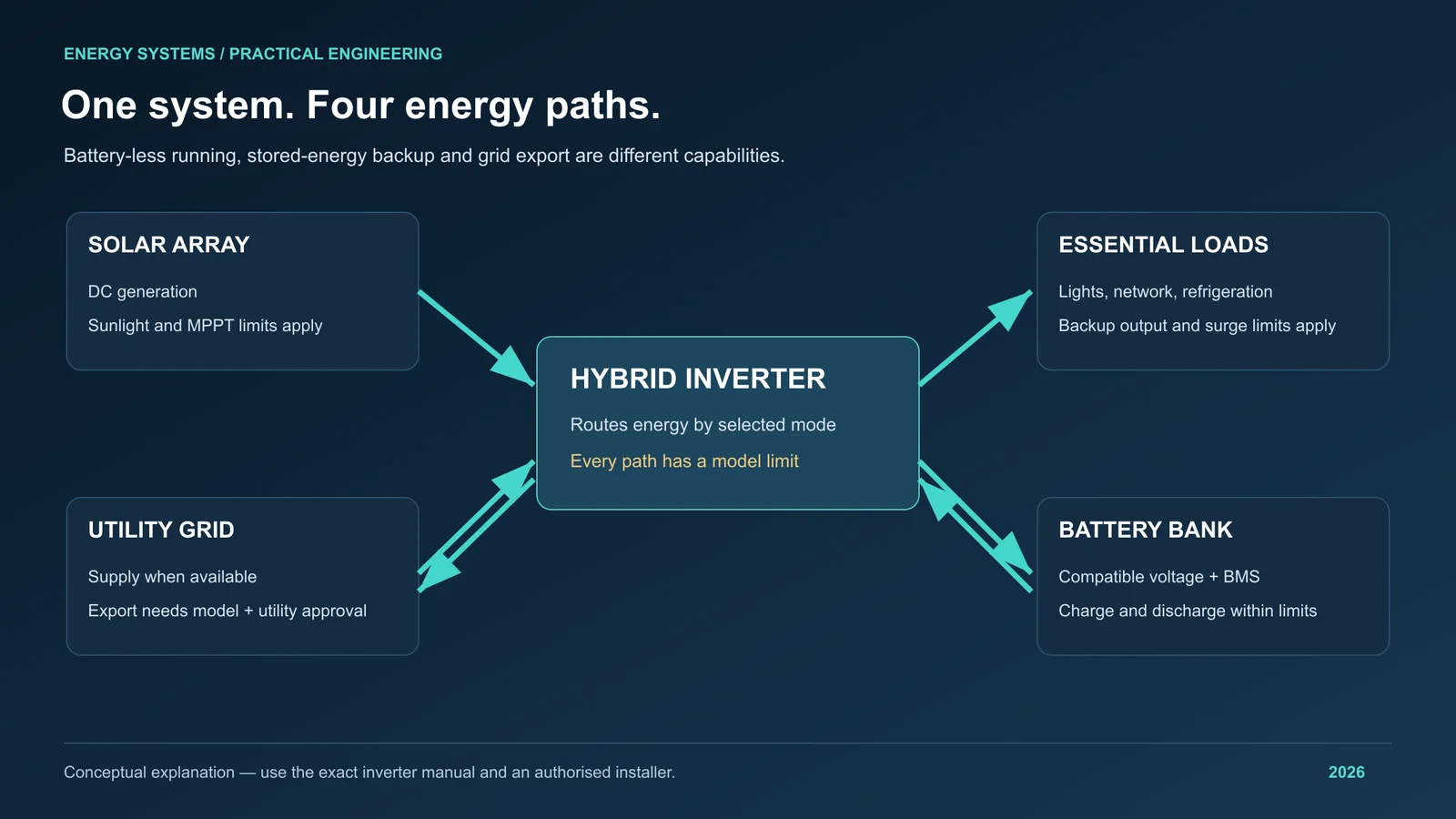
A battery-less capable inverter is useful when a business wants to begin with daytime solar and add storage later. It does not guarantee that a shop will continue running through every cloud transition or a night-time power cut. Request the exact model's operating conditions and demonstrate the intended source-loss behaviour before relying on it for critical equipment.
Grid export is another separate function. Check the supplied inverter's export capability, required protection and the applicable utility approval. An inverter's ability to manage solar and batteries does not by itself establish permission to export electricity.
24V versus 48V: compare current as well as watts
At the same power, a lower battery voltage requires more current. A 5kW load divided by a nominal 25.6V battery voltage is about 195A before inverter losses. Real DC current depends on the battery voltage and conversion losses, so it can be higher. This is why a 5kW inverter connected to one 100Ah battery is not automatically a 5kW battery-backup system.
For the confirmed 100Ah Devsol/Nexus Solar Energy packs with a 100A continuous BMS limit, the recommended discharge basis is 0.5C, or 50A. At nominal voltage, a 25.6V pack supplies 1.28kW DC at 50A; a 51.2V pack supplies 2.56kW DC at the same current. Available AC power is lower after inverter losses. These calculations explain sizing; they are not a new inverter output rating or a runtime guarantee.
Use the exact battery model and approved expansion arrangement. Parallel capability, communication settings, protection, cable sizing and equal current sharing must be checked as a system. Do not combine batteries merely because their labels show similar voltage.
Calculate backup from usable energy
Power is measured in kW; energy is measured in kWh. A nominal 51.2V 100Ah battery stores 5.12kWh before reserve, discharge limits and losses. That figure is not a promise that 5.12kWh will reach the connected appliances.
Use this planning relationship: backup hours ≈ usable battery energy delivered as AC ÷ average supported load. As an illustration, if a system design makes 3kWh available to essential circuits, a steady 600W load has a five-hour arithmetic estimate. Actual duration changes with duty cycles, starting events, temperature, battery condition and the reserve settings.
Ask the supplier to show both the maximum simultaneous load and the energy budget. A proposal that shows only battery amp-hours leaves out the operating voltage; one that shows only inverter kilowatts leaves out duration.
Charging current: faster hardware still needs the right settings
A high-current charger is useful only when the battery bank can accept that current and enough charging power is available. Set the solar and grid charging limits to the approved battery specification and the commissioning design. A charger maximum must never be treated as the automatic setting for every battery.
Charging twice the energy in a similar time requires roughly twice the average charging power, with allowance for efficiency and charging behaviour. Battery count alone is not a valid comparison: series and parallel arrangements change voltage, current and energy differently. Give the installer the battery chemistry, voltage, capacity, BMS limits and intended daily use.
What a fair brand comparison should contain
Use the same questions when considering Devsol, MuscleGrid or Luminous: the exact model, running and backup ratings, DC limits, enclosure, included accessories, standard warranty, delivered cost and service route. A 24V indoor inverter should not be presented as identical to a 48V outdoor-rated product simply because both are called hybrid.
The official MuscleGrid Titan 6.2kW 48V listing publishes a 120A charger and separate warranty options. The official Luminous NXH 150 A48 listing describes its 48V battery support and monitoring. Those are reasons to compare exact configurations, rather than assume charging current or app monitoring is exclusive to one brand.
For Devsol, the useful distinction is a clearly specified complete solution: the appropriate inverter, a matched battery proposal, relevant demonstration, accessible documentation and a defined repair contact. Ask for that evidence with the quotation.
Watch the model, then match it to your quotation
Deepak Chaudhary's public demonstrations can help you see controls, displays and example loads. They complement the manual and site design; they do not replace the operating limits of the supplied model.
- 5kW 24V inverter: daytime operation demonstration — look at the shown source, display readings and connected equipment.
- 5kW model: air-conditioner demonstration — compare the demonstrated setup with your own electrical inputs; do not infer a universal AC count.
- 15kW three-phase inverter: model walkthrough — use the three-phase manual for the actual design and commissioning limits.
Fault codes must match the exact inverter
Photograph the complete display message, model label and the conditions when the warning occurred. Record whether solar, grid and battery were available and which loads were operating. A warning, a protective shutdown and a hardware fault are different events.
Use the manufacturer's model-specific technical library, including the Devsol 15kW three-phase user manual for that model. Do not apply a code table from a similar-looking inverter or a different voltage family. Follow owner checks in the matching manual and escalate persistent faults to service. Internal inspection, live measurements, repair and protection changes belong to qualified technicians.
The following examples apply to the 15kW three-phase manual, not the DEV HYD 5kW or every Devsol inverter:
| Code | Manual description | Owner handover to service |
|---|---|---|
| E017 | System over-temperature | Record the code, operating load and installation conditions; follow the matching manual and contact service if it persists. |
| E202 | Inverter overload | Record which equipment was operating or starting when the event occurred; request a load assessment. |
| E301 | Grid-voltage error | Record the displayed information and time of the event for the authorised installer. |
| E104 | Phase A meter/CT missing | Pass the complete message to the installer; do not change live meter or CT wiring yourself. |
These references are listed in the manual's fault section, pages 59–60. Give support the model, serial number, firmware shown, timestamp and a clear display photograph. A code description identifies an investigation path; it is not a remote diagnosis of the failed component.
Plan service before the first power cut
Devsol's service offering includes post-warranty repair support and a Bhopal repair setup. Keep the invoice, serial number, installation record and the appropriate warranty terms with the system handover. For an out-of-warranty job, request diagnosis, the parts-and-labour quotation and transport arrangements before approving repair.
A business also needs to know how its essential operations will continue while equipment is being serviced. Ask the service contact about the options available for your location and fault. Replacement, collection, repair time and charges depend on the applicable terms and the assessed case; a generic network claim is not a fixed turnaround commitment.
OEM and project enquiries are welcome for businesses that need a specified configuration or a branded supply arrangement. Define the capacity, enclosure, interface, documentation, certification scope, warranty responsibility and acceptance checks in writing. The scope should be agreed for the actual supplied model.
Your business-inverter handover checklist
- Exact inverter model, phase, battery voltage and applicable warranty.
- Essential and optional circuits, running load, motor-start checks and interruption requirements.
- PV-string voltage/current design, protection and approved export configuration.
- Battery model, usable-energy basis, charge/discharge settings and communication configuration.
- Recorded source-loss demonstration for the supported circuits.
- Model-matched manual, fault-report procedure and warranty/post-warranty service contact.
- Final invoice and delivered scope, including installation and transport where applicable.
Choose the Devsol model around the work your business must keep doing. Send the appliance list, daily operating hours, supply phase, roof details and desired backup period to Devsol for a matched inverter-and-storage proposal.